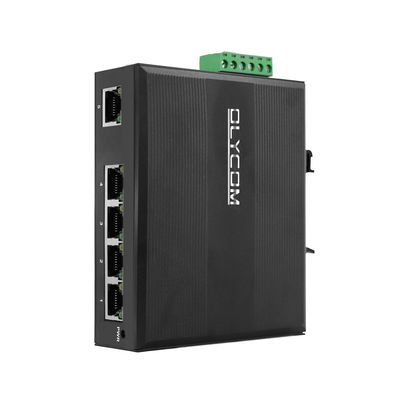
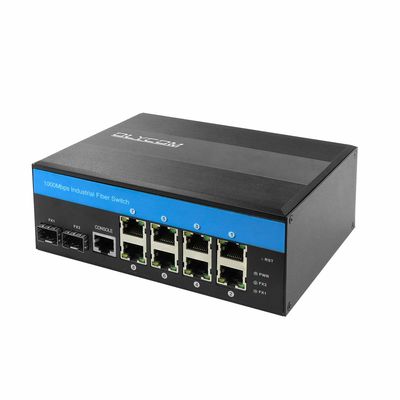
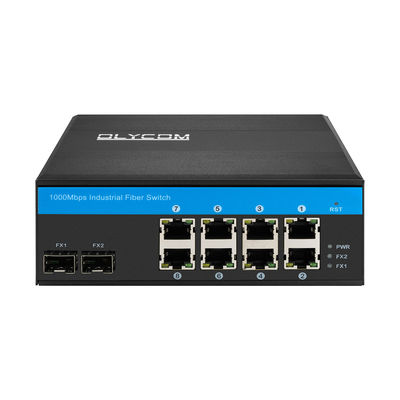
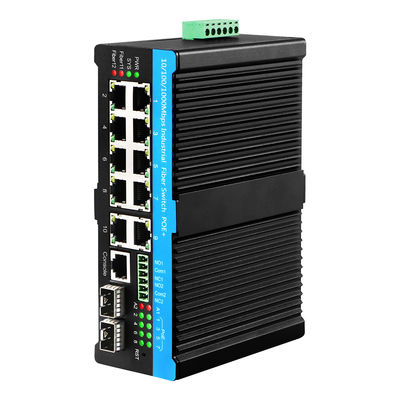
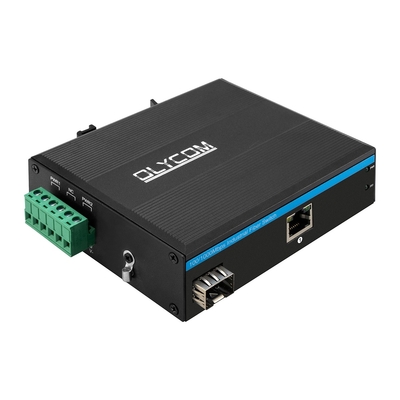
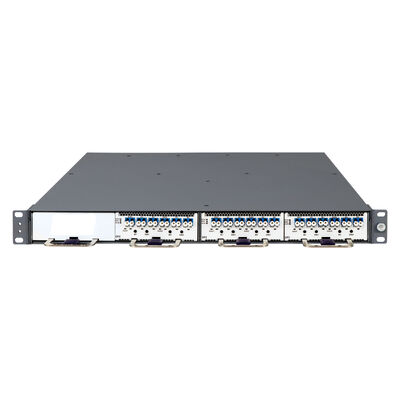
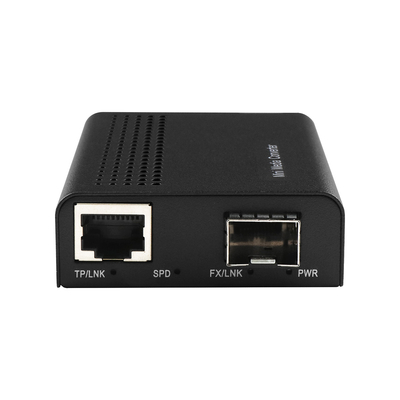
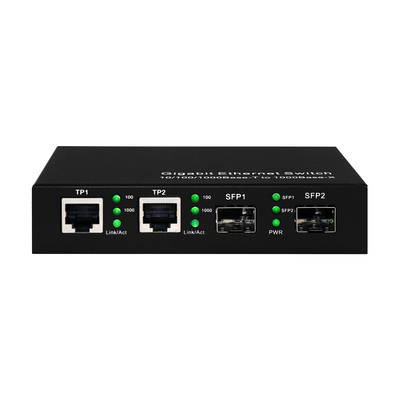
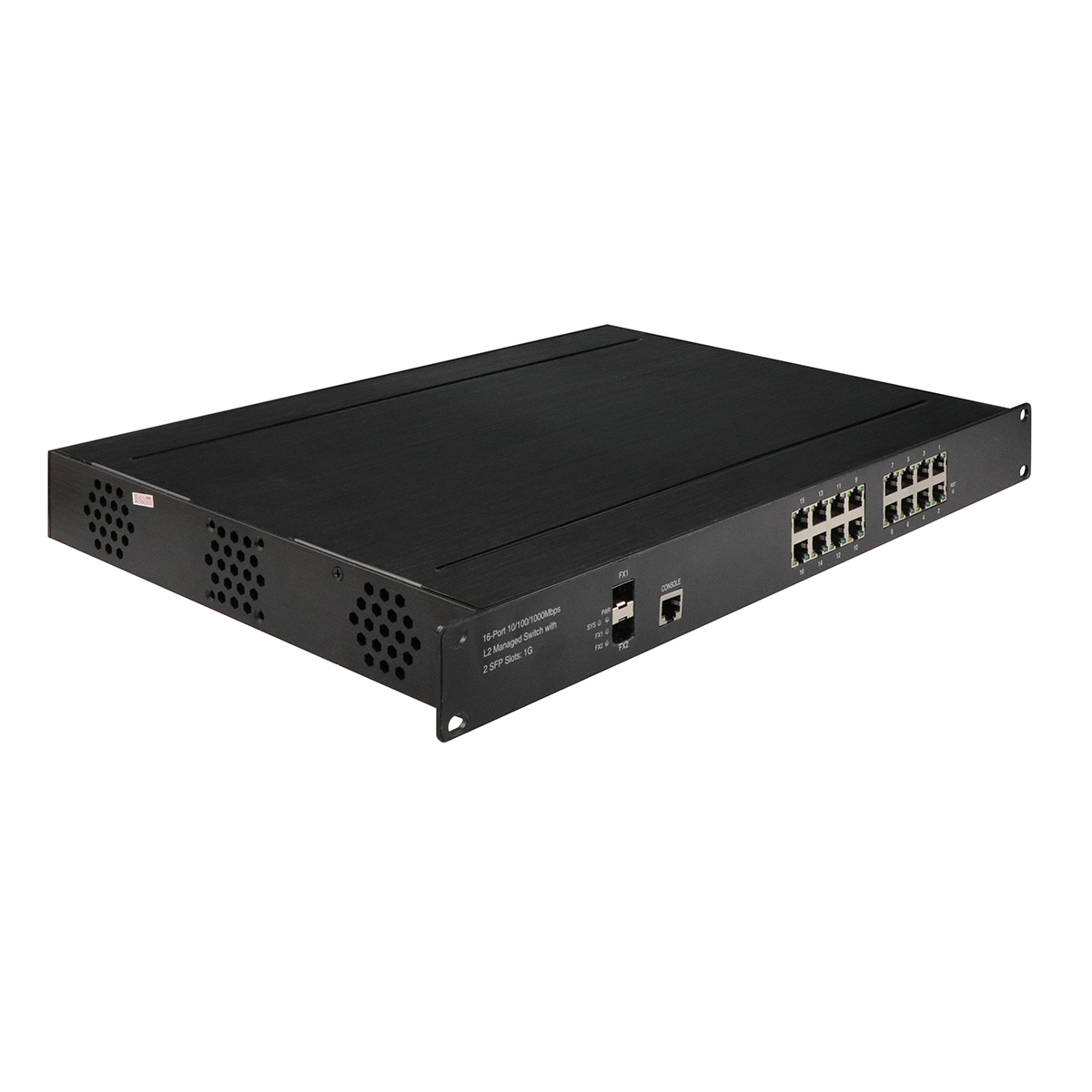
2.5G L2+ Managed 16 Port Industrial Fiber Switch
Technical Data
|
Product Name
|
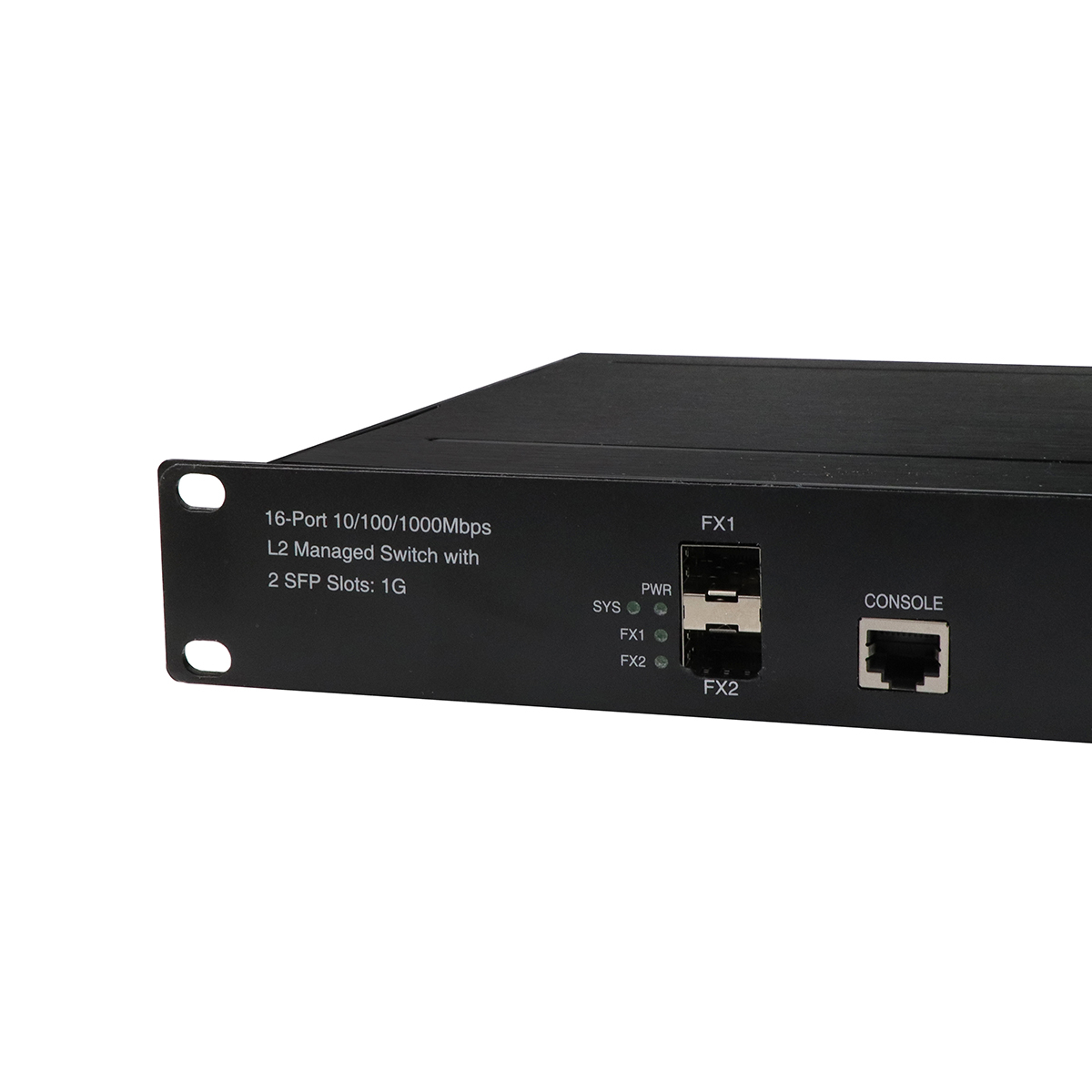
10/100/1000Mbps Industrial Fiber Switch (2F+16TP)
|
|
Model No.
|
IM-FS021600GW
|
|
Port
|
2 x 1000Mpbs SFP ports
16x10/100/1000M UTP RJ45
|
|
Standard
|
IEEE 802.3, IEEE802.3U, IEEE802.3ab, IEEE802.3z, IEEE802.1d STP, IEEE802.1w RSTP, IEEE802.1s MSTP, ITU-T G.8023 EPR/Y.1344, IEEE802.1Q, IEEE802.1X, IEEE802.3ad, IEEE802.3x, IEEE802.3af, IEEE802.3at, IEEE802.1ad, IEEE802.1p, IEEE802.1ab, IEEE802.3az
|
|
VLAND ID
|
4096
|
|
Jumbo Frame
|
9.6KB
|
|
MAC Address Table Size
|
8K
|
|
Switching features
|
Transmission mode: storage and forward
System bandwidth: 36Gbps (non-traffic jam)
|
|
Network media
|
10BASE-T: CAT3, CAT4, CAT5 un-shielded twisted pair(≤100m)
100/1000BASE-TX: CAT5 or above shielded twisted pair(≤100m)
SFP port, transmission distance: 20Km, 40Km, 60Km, 80Km, 100Km
|
|
LEDs
|
Power, network, fiber
|
|
Power supply
|
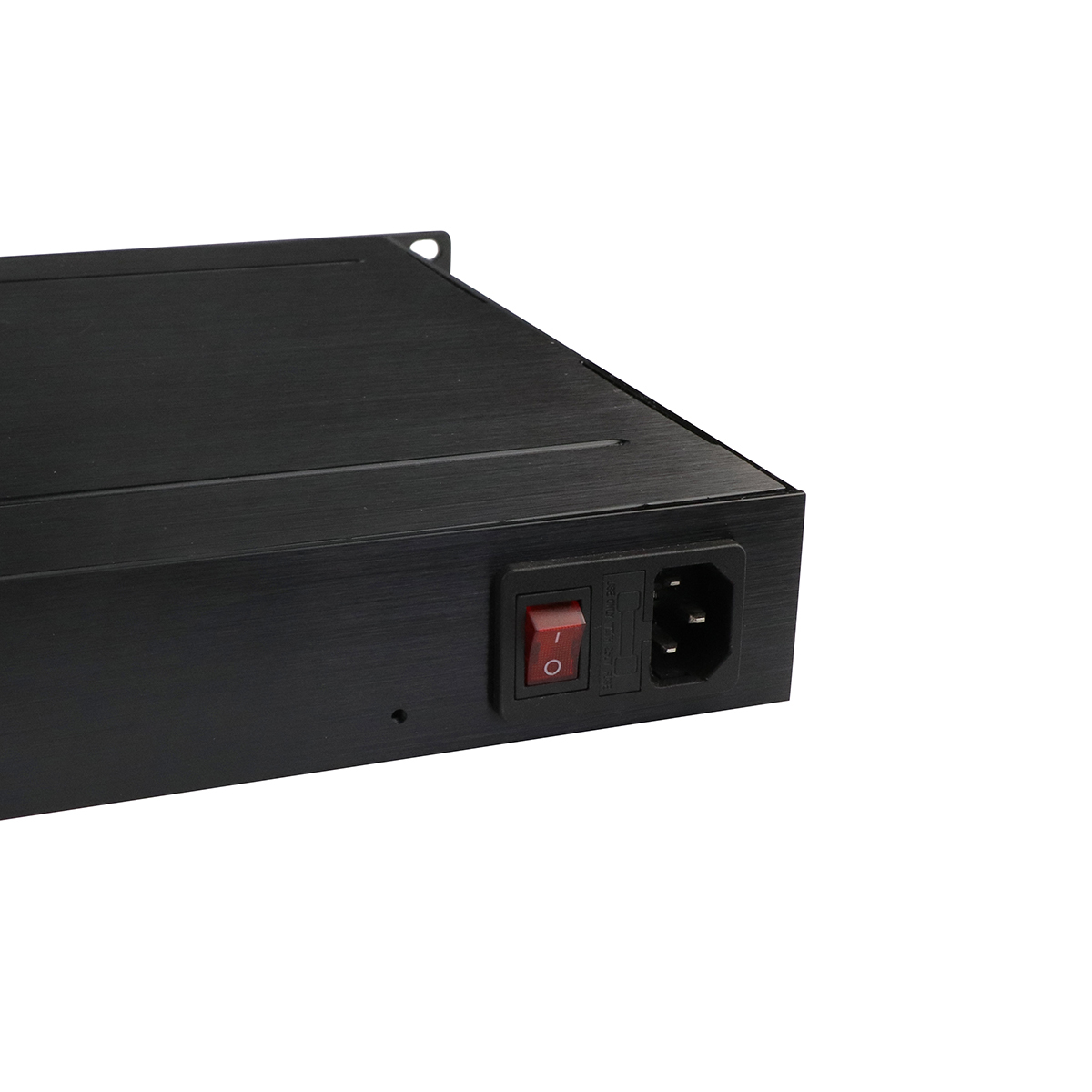
Input voltage: AC220V
Non-polar power input: support
|
|
Environment
|
Working temperature: -40℃~ 85℃
Working humidity: 5%~95%, non-condensing
|
|
Industry Standards
|
EMI: FCC Part 15 Subpart B Class A, EN 55022 Class A, EN61000-6-4- Emission for industrial environment
EMS: EN61000-6-2-Immunity for industrial environment, EN 61000-4-2 (ESD) Level 3, EN 61000-4-3 (RS) Level 3, EN 61000-4-4 (EFT) Level 3, EN 61000-4-5 (Surge) Level 3, EN 61000-4-6 (CS) Level 3, EN 61000-4-8
Traffic Control: NEMA-TS2, Vibration: IEC 60068-2-6
Freefall: IEC 60068-2-32, Shock: IEC 60068-2-27
Rail Traffic: EN 50121-4
|
|
Mechanical information
|
Safety class: IP30
Dimension: 483x 275 x 44.5mm
|
|
Warranty
|
Replacement within 1 year; 3 years repairing
|
Product Positioning
IM-FS021600GW is positioned as an industrial-class Ethernet aggregation switch built for environments where large numbers of devices, long cable runs, and harsh operating conditions coexist. It is designed to operate continuously in infrastructure-level networks that demand predictable performance, strict isolation, and long-term stability rather than consumer-style throughput bursts.
1. Network Architecture & Capacity
The device provides a dual-fiber uplink design combined with high-density copper access, allowing it to act as a local aggregation node or an industrial access switch within distributed control networks. Two optical interfaces support long-distance transmission over both single-mode and multi-mode fiber, enabling interconnection between control rooms, substations, workshops, or remote sites. Sixteen Gigabit Ethernet ports accommodate dense field-device connectivity without the need for external expansion equipment.
A non-blocking switching fabric with high forwarding capacity ensures simultaneous traffic flows can be processed without congestion. Large address and VLAN tables allow the network to scale as systems grow, supporting segmented architectures across multiple departments, functions, or security zones.
2. Redundancy, Stability & Traffic Control
Designed for always-on industrial operation, the switch integrates multiple mechanisms to maintain network continuity. Ring-based protection and spanning tree protocols enable fast topology convergence and automatic recovery from link or node failures, preventing single-point outages in critical networks.
Traffic handling is optimized through store-and-forward processing and support for jumbo frames, ensuring efficient transmission of large industrial data packets. Quality-of-Service mechanisms allow latency-sensitive traffic—such as control signals or monitoring streams—to be prioritized, while bandwidth control and storm suppression prevent abnormal traffic from affecting overall system stability.
3. Segmentation & Multicast Optimization
The platform supports a wide range of VLAN deployment models, enabling networks to be logically divided based on ports, MAC addresses, IP subnets, or application protocols. VLAN translation allows different network domains to interconnect without reconfiguration.
For multicast-heavy environments, the switch includes advanced multicast control functions. IGMP and MLD snooping and filtering mechanisms ensure multicast traffic is delivered only where required, reducing unnecessary bandwidth consumption in applications such as video surveillance and real-time monitoring.
4. Security & Access Control
Security is enforced through multiple layers, beginning at the port level and extending through authentication, authorization, and encrypted management access. The switch supports standardized authentication frameworks and access control policies to restrict unauthorized devices and users.
Additional protection mechanisms help mitigate common network threats such as spoofing and unauthorized address usage. Secure management protocols ensure configuration data and control traffic remain protected during remote access and maintenance.
5. Management & Maintenance
The device can be managed using multiple interfaces to suit different operational preferences, including command-line access, web-based configuration, and centralized network management platforms. Remote software maintenance is supported with safe upgrade mechanisms designed to prevent service interruption due to failed updates.
Built-in diagnostic tools assist with fault localization, reducing troubleshooting time in large installations. Support for time synchronization, logging, and monitoring standards enables seamless integration into existing operational workflows.
6. Environmental & Mechanical Design
The switch is built for deployment in physically demanding environments. A metal enclosure with industrial dust protection, combined with wide operating and storage temperature ranges, enables reliable operation in locations exposed to heat, cold, and airborne contaminants.
Compliance with a broad set of industrial, electromagnetic, and transportation-related standards ensures the device can be deployed in specialized environments such as rail systems, outdoor cabinets, and energy facilities. Resistance to vibration, shock, and electrical interference further enhances operational durability.
7. Power & Installation
Designed for infrastructure-level deployment, the switch supports AC power input with non-polar connection tolerance, simplifying installation in industrial electrical systems. The chassis form factor is suitable for rack-mounted installations in control rooms, substations, and industrial equipment cabinets.
Deployment Use Cases
1. Factory Control and Automation
Serves as an access and aggregation layer for automation networks, connecting controllers, sensors, HMIs, and monitoring systems while isolating traffic through VLAN and QoS mechanisms.
2. Railway and Transportation Systems
Applied in trackside, station, and roadside networks where compliance with rail standards and rapid fault recovery are essential to maintain signaling and information services.
3. Power and Utility Networks
Used in substations, renewable energy sites, and grid monitoring systems, supporting redundant network designs and wide environmental tolerance for outdoor and underground deployment.
4. Heavy Industry and Resource Sites
Deployed in mining, metallurgy, and petrochemical facilities where dust, vibration, and electrical noise are common, while remote diagnostics reduce maintenance effort.
5. Industrial Campus and Backbone Interconnection
Acts as a fiber-connected aggregation switch linking data centers, industrial parks, and control facilities, supporting high-volume data exchange and scalable expansion.
6. Security and Remote Monitoring
Supports large-scale camera and monitoring systems through efficient multicast handling and traffic prioritization, maintaining separation between surveillance and operational networks.
7. Public Transit Infrastructure
Integrated into rail and transit communication systems to provide resilient connectivity for onboard, wayside, and station-level equipment.

Software Features
- Support cable diagnosis and can locate the fault point
- Support IEEE802.3az EEE(Energy Efficient Ethernet) Management, optimize power consumption
- Support STP, RSTP, MSTP, ITU-T G.8032 Ethernet Protection Ring(EPR)
- Support QoS, transport classification QoS, CoS, bandwidth control(input/output direction), storm suppression, differentiated services
- Support IEEE802.1q VLAN, VLAN port, based Mac VLAN, IP subnet VLAN, Protocol VLAN, VLAN convert, MVR
- Support dynamic IEEE802.3ad LACP link aggregation, static link aggregation
- Support IGMP/MLD snooping V1/V2/V3, IGMP filtrating/ modulating, IGMP searching
- Support IGMP agent report, MLD snooping
- Safety: based on port and Mac IEEE802.1X, RADIUS, ACL, TACACS+, HTTP/HTTPS, SSL/SSH v2
- Support Cisco® like CLI, Web management, SNMP v1/v2c/v3, Telnet
- Support software upgrade via TFTP and HTTP, firmware redundancy prevents upgrade failing
- Support DHCP client/Relay/Snooping/Snooping option 82/Relay option 82
- Support RMON, MIB II, mirror image, event log, DNS, NTP/SNTP, IEEE802.1ab LLDP
- Support IPV6 Telnet server/ICMP v6, SNMP, HTTP, SSH/SSL, NTP/SNTP, TFTP, QoS, ACL
FAQ
1, What chip is it based?
Olycom: Vitesse
2, Can I customize it?
Olycom: Yes
We support OEM services like logo, model name, label, PVC mask and product parts(mounting kit, power terminal block etc.)
3, Can I connect it with 10/100M devices?
Olycom: Yes
For LAN ports, they are 10/100/1000M auto-sensing
For Fiber ports, please configure 100Mbps speed via Web GUI or CLI
4, Can I shut down PoE function for some ports when necessary?
A: Yes
All the PoE managed switches in this series support PoE management
Please just set PoE status via Web GUI or CLI
5, Do you do SKD/CKD?
A: Yes
As a factory, we have dealt with this many times.


 Your message must be between 20-3,000 characters!