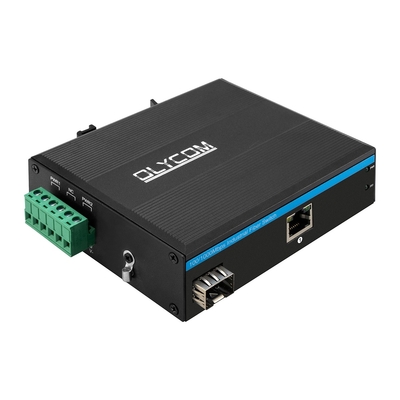
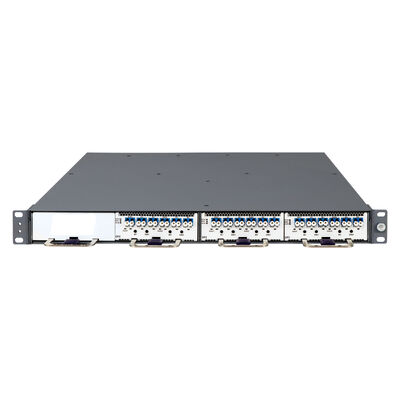
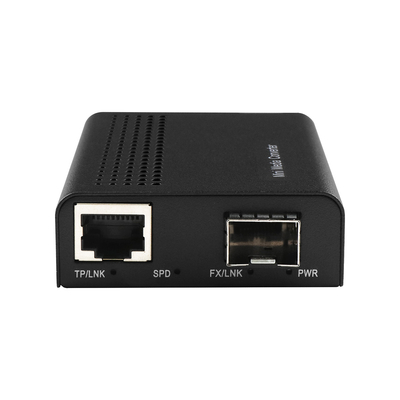
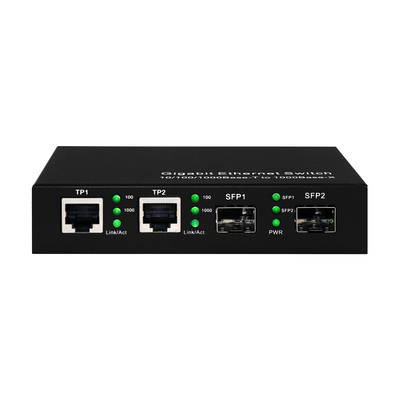
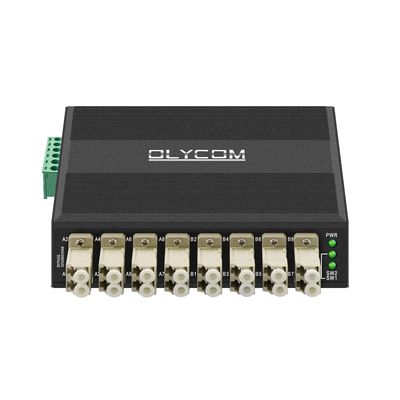
DC24V 1x2 2x2 4x4 MM Fiber Optic Bypass switch
Introduction of 8 channel Bypass Switch
OM-FBS-44-MLC is an external fiber bypass unit for critical optical-nodes in optical network system.
- It supports 100G/40G/10G/1G and 100M fiber connections and offers LC multimode option.
- It is usually used in some major optical networks involving ring connection and multiple devices such as in railway communication systems, factory automation and important optical nodes where intended or unexpected power loss occurs.
Product Features of Optical Fiber Bypass
- Available in existing/new optical nodes
- Support Din/Wall mounting
- Industrial removable green terminal block
- Operating temperature: -20℃ ~70℃
- Robust IP40 level housing
- Bypass switching time ≤10ms
- Low insertion loss, low channel crosstalk
- DC9V~DC52V redundant power input
Specification of optical Bypass Unit
| Product Name |
Optical Fiber Bypass Switch |
| Power Interface |
Standard industrial terminal block. |
| Polarity Protection |
Support |
| Optical Fiber Interface |
LC |
| Wavelength Range |
850±40/1300±40nm; 1260~1650nm |
| Test Wavelength |
850/1300nm; 1310/1550nm |
| Insert Loss |
Typ:0.6 dB Max:1.0 dB ; Typ:0.6dB Max:1.0 dB |
| Return Loss |
MM≥30 dB SM≥50 dB |
| Channel Crosstalk |
MM≥35 dB SM≥55 dB |
| Polarization Loss |
≤0.05 dB |
| Wavelength Loss |
≤0.05 dB |
| Temperature Loss |
≤0.05 dB |
| Repeatability |
≤0.05 dB |
| Operating voltage |
DC9V-52V |
| Service life |
≥100000000 times |
| Switching time |
≤10 ms |
| Transmission optical power |
≤500 mw |
Application diagram of fiber bypass switch

- Easy power control for networking system
- System Monitoring
- Smart protection of optical paths
What is bypass switch?
Bypass unit or module is usually used to protect the network system(bypassing the device it connects) when power is suddenly off.
In a linear network system(like below diagram), the transmission is fine if the data/SFP/power is normal.
What if any power supply is off (like power surge, striking, man-made damage...)
The whole network system will fail.
Another situation is, power overhaul/maintenance is required for switch 2(the middle one) area, lets say for 12 hours, the whole system got to stop.
With a bypass module/switch, it is like putting in a protection mechanism in the whole system.
A bypass switch helps protect the whole system if one or many switches fail at the same time.
Packing List
- 1pc optical fiber bypass switch
- 1pc user manual
- 1pc warranty card
Quality Control Overview
For networking and optical communication products, reliability depends on a well-structured quality system rather than isolated testing steps.
At OLYCOM, quality control is implemented across the entire product lifecycle—from component sourcing to final delivery—to ensure consistent performance in real deployment environments.
All materials are verified before production, including optical modules, electronic components, and mechanical structures. During manufacturing, automated inspection systems are used to maintain accuracy in assembly and reduce variability.
Each product undergoes functional validation, covering data transmission performance, feature operation, and power delivery where applicable. For optical systems, parameters such as wavelength accuracy, signal quality, and transmission stability are carefully evaluated.
To ensure long-term reliability, devices are tested under extreme conditions, including temperature variation, humidity exposure, and mechanical stress. In addition, extended run-time testing is conducted to identify potential early failures.
Every unit is subject to final inspection before shipment, with full traceability supported by documented test records and compliance data.
By combining standardized processes with continuous improvement, OLYCOM ensures stable, durable, and field-ready networking solutions.


 Your message must be between 20-3,000 characters!