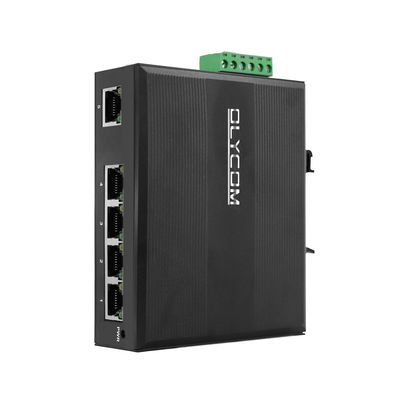
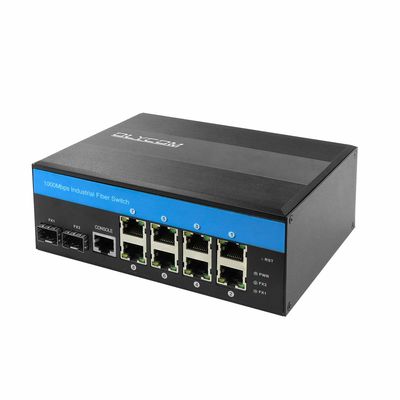
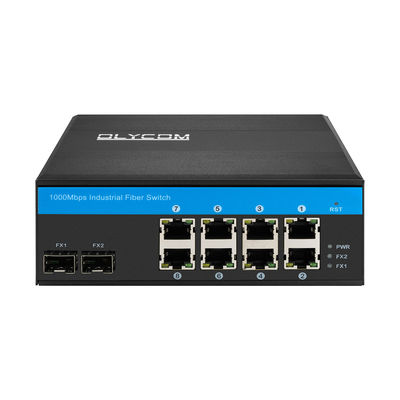
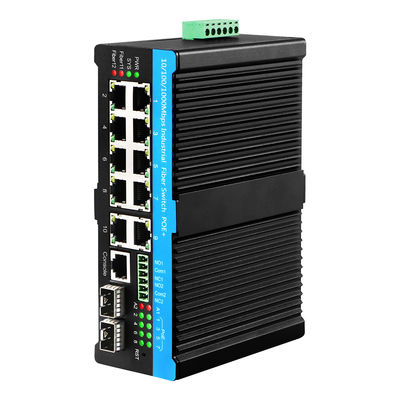
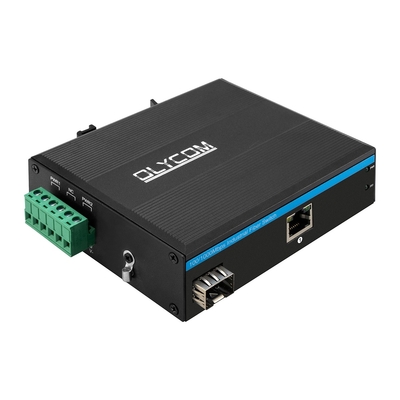
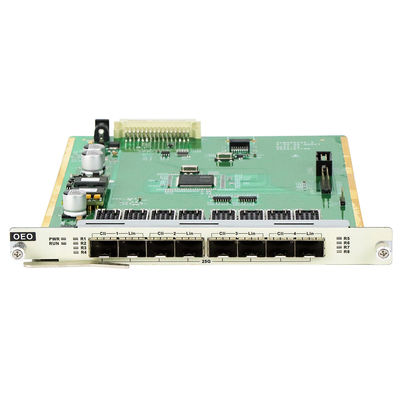
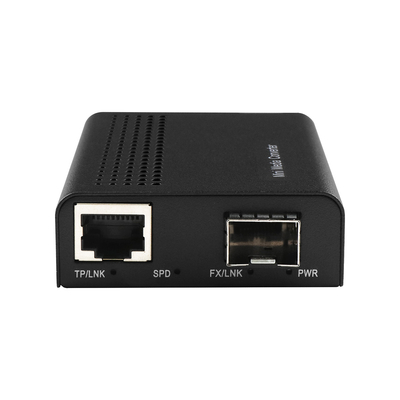
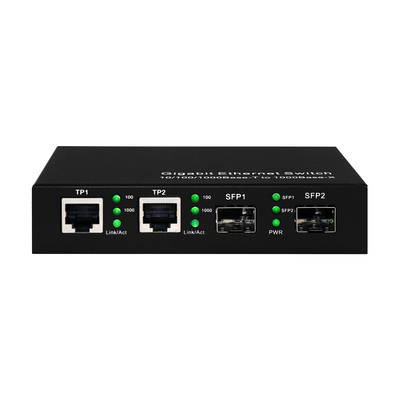
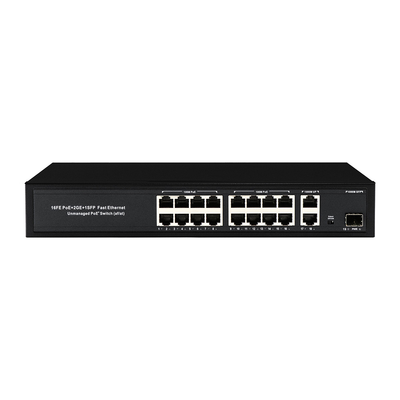
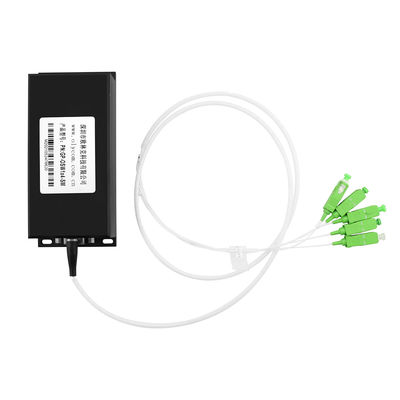
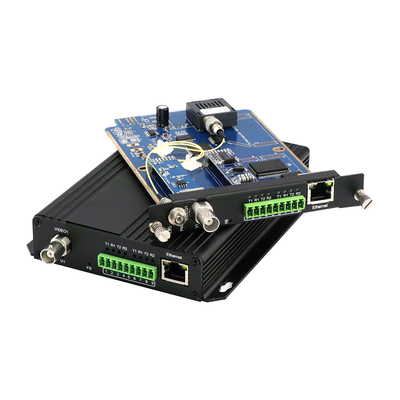
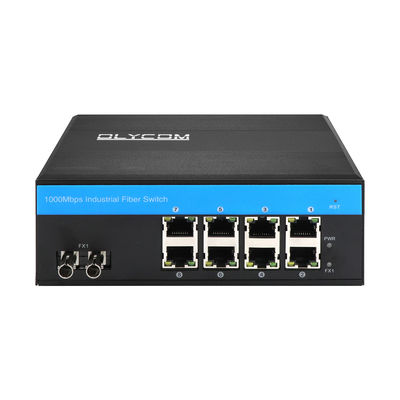
Olycom Industrial Unmanaged Ethernet Switch with ST Connector
Introduction to Industrial Network Switch
IMN-FS180GE series is the 10/100/1000Mbps industrial unmanaged Ethernet switch with the below features
- support wide voltage dual power input, DC12V~DC52V
- operating temperature -40 ℃ to + 75 ℃
- meet IP40 protection degree and EMC industrial grade requirements
- pass through dangerous environmental certification and comply with FCC and CE standards
Key Features of Rugged Ethernet Switch
-
6KV Ethernet surge protection
-
IEEE 802.3 10Base-T and IEEE 802.3u 100Base-TX compliant
-
Flow control mode: full duplex with IEEE 802.3x standard, half-duplex with Back pressure standard
-
ST fiber uplink, duplex 30KM distance
-
8 x 10/100/1000Mbps auto-sensing RJ45 downlink ports
Specification of Industrial unmanaged switch
| Product Name |
10/100/1000Mbps Industrial Fiber Switch(1Fiber+8TP) |
| Model No. |
IMN-FS180GE-ST |
| Port |
1pc singlemode ST fiber uplink, 30km
8pcs 10/100/1000M UTP RJ45(Support MDI/MDIX auto-sensing)
|
| Switching features |
Transmission mode: storage and forward
System bandwidth: 18Gbps (non-traffic jam)
|
| Network media |
10BASE-T: CAT3, CAT4, CAT5 un-shielded twisted pair(≤100m)
100/1000BASE-TX: CAT5 or above shielded twisted pair(≤100m)
|
| LEDs |
Power, network |
| Power supply |
Input voltage: DC 12-52V
No-load power: 5W
Reverse connection: support
|
| Environment |
Working temperature: -40°~75°C
Storage temperature: -40°~ 85°C
Working humidity: 10%~90%,non-condensing
Storage humidity: 10%~95%,non-condensing
|
| Industry Standards |
EMI: FCC Part 15 Subpart B Class A,EN 55022 Class A
EMS: EN 61000-4-2 (ESD) Level 3,EN 61000-4-3 (RS) Level 3, EN 61000-4-4 (EFT) Level 3,EN 61000-4-5 (Surge) Level 3, EN 61000-4-6 (CS) Level 3,EN 61000-4-8
Traffic Control: NEMA-TS2 Vibration: IEC 60068-2-6
Freefall: IEC 60068-2-32
Shock: IEC 60068-2-27
Rail Traffic: EN 50121-4
|
| Safety |
CE Mark, commercial
E-mark(please contact us if certification copy is required)
CE/LVD EN60950
|
| Mechanical information |
Shell: Corrugated metal shell
Safety class: IP40
Dimension: 158 x 115x 60mm
Mounting method: Din-rail mounting
|
| Warranty |
Replacement within 1 year; 3 years repairing |
Quality Control Framework
Maintaining high product quality is essential for ensuring reliable operation in modern telecommunications networks. A robust quality control framework helps guarantee that networking and optical communication equipment consistently meets performance expectations, environmental requirements, and customer specifications throughout its service life.
1 Quality Standards and Compliance
The quality management system is developed in accordance with internationally recognized standards and industry regulations. Manufacturing, testing, and inspection activities comply with ISO 9001 quality management requirements as well as relevant CE, FCC, RoHS, IEEE, and ITU-T standards.
In addition to regulatory compliance, customer-specific requirements are incorporated into the quality assurance process. Key performance indicators such as throughput, latency, power consumption, transmission stability, and environmental durability are defined and monitored throughout production to ensure products meet application-specific expectations.
2 End-to-End Quality Control Process
Quality control is implemented across the entire product lifecycle, from incoming material inspection to final shipment.
Incoming Quality Control (IQC) serves as the first layer of quality assurance. Critical components, including optical modules, printed circuit boards, power supplies, integrated circuits, connectors, and mechanical assemblies, are inspected to verify compliance with engineering specifications and procurement standards.
During the manufacturing stage, production control procedures are applied to maintain process consistency and assembly accuracy. Automated inspection systems and process monitoring methods help identify defects early, reducing production variability and improving overall product reliability.
Following assembly, products undergo comprehensive functional testing to verify operational performance. Network devices are tested for switching capacity, data forwarding efficiency, VLAN functionality, QoS implementation, and PoE power delivery where applicable. Optical communication equipment is evaluated for transmission quality, wavelength accuracy, optical power levels, and signal integrity.
3 Reliability and Environmental Testing
Telecom equipment is often deployed in demanding environments where stable operation is critical. To verify long-term reliability, products are subjected to a series of environmental and stress tests.
Testing procedures may include:
* Wide-temperature operation verification from -40°C to +75°C
* High-humidity exposure testing
* Mechanical vibration and shock simulation
* Thermal stability assessment
* Continuous operational stress testing
These evaluations help confirm product durability and ensure reliable performance under real-world operating conditions.
4 Burn-In and Stability Verification
Burn-in testing is conducted to identify potential early-life failures before products reach customers. Equipment operates continuously under controlled load conditions while key parameters such as throughput, packet transmission quality, optical performance, temperature behavior, and power stability are monitored.
This process improves overall product consistency and reduces the likelihood of field failures after deployment.
5 Testing Equipment and Validation Tools
Accurate measurement and verification require advanced testing resources. The quality laboratory is equipped with professional instruments designed to validate both networking and optical transmission performance.
Key testing equipment includes:
* Optical Spectrum Analyzers (OSA) for optical signal evaluation
* Traffic Generators for throughput and latency testing
* Protocol Analyzers for network communication verification
* Environmental Chambers for temperature and humidity testing
* Vibration Testing Systems for mechanical reliability validation
These tools provide comprehensive performance analysis and support consistent product qualification.
6 Quality Management and Traceability
A complete quality management system ensures full traceability throughout the manufacturing process. Inspection records, production data, calibration reports, and test results are systematically documented and maintained.
This traceability enables rapid identification of components, manufacturing batches, testing history, and corrective actions when required, supporting efficient quality management and customer service.
7 Continuous Improvement
Quality enhancement is driven through continuous improvement initiatives. Root Cause Analysis (RCA) methodologies are used to investigate defects, identify underlying issues, and implement corrective and preventive actions.
Customer feedback, field performance information, and internal quality metrics are regularly reviewed to improve manufacturing processes, optimize product design, and enhance long-term reliability. Ongoing employee training further strengthens quality awareness and operational excellence across all production activities.
8 Result
By combining strict quality standards, comprehensive testing procedures, advanced validation tools, and continuous process improvement, telecom equipment can achieve higher reliability, lower failure rates, improved network performance, and reduced maintenance costs throughout its operational lifecycle.
Dimension of 9 port Ethernet fiber switch

Company Profile
We manufacture and market fiber optic connectivity devices.
We provide solutions and services of industrial fiber switch, fiber to copper media conversion, Ethernet networking, and CCTV video surveillance.
- We are a 20-year-old manufacturer with production lines and basically provide
- 2 4 6 8 10 12 16 port din-rail gigabit industrial L2 L3 managed switch
- Normal POE fiber optic Ethernet media converter
- 14 slots 16 slots media converter chassis rack
- AHD TVI CVI Analog video to fiber converter
- Customized data video Ethernet phone audio contact closure over fiber optic extender converter SFP copper fiber transceiver
- Serial to fiber optic converter


 Your message must be between 20-3,000 characters!