|
Standards
|
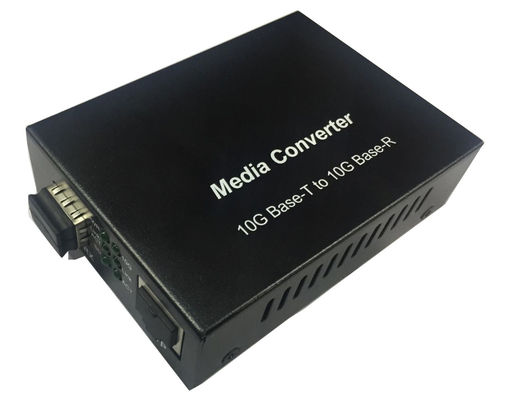
1000Base-T, 2.5GBase-T, 5Gbase-T, 10Gbase-T
1000Base-X, 2500Base-X, 5GBase-R , 10GBase-R
|
|
Media Supported
|
1000Base-T: Cat5 UTP/STP. MAX 100m
2.5GBase-T: Cat5e UTP/STP. MAX 50m
5GBase-T: Cat5e UTP/STP. MAX 50m
10G Base-T: Cat6a UTP/STP. MAX 50m
|
|
Port Type
|
RJ45, SFP Slot
|
|
Work Mode
|
1000Base-T to 1000Base-X
2.5GBase-T to 2500Base-X
5Gbase-T to 5GBase-R
10Gbase-T to 10GBase-R
|
|
Support Modules
|
10GBASE-SR/LR/ER/ZR
50/125μm or 62.5/125μm multi-mode fiber optic cable, up to 300m
9/125μm single-mode fiber optic cable, up to 10/40/80km
|
|
Power Supply
|
12V DC
|
|
Power consumption
|
MAX 5W
|
|
Operation Temperature
|
0℃ to 55℃
|
|
Relative Humidity
|
5% to 80% (non-condensation)
|
Interface of Unmanaged Media Converter

LED Description of 10G Media Converter
| LED |
Status |
Description |
| PWR |
On |
Power is on and normal. |
|
FX Link/Act
|
On
|
Connection status display for Fiber Link. “ON” indicates that Fiber link is in correct connection. |
|
Blink
|
Active status display of fiber link.
“Blink” indicates packet goes through FX end.
|
| SD |
On |
Fiber signal is detected. |
|
10G
|
On |
Transfer rate of electric interface is 10Gbps. |
| Off |
Rate of electric interface is 10Mbps. |
|
TX Link
|
On
|
Connection status display for electric link.
“ON” indicates that electric link is in correct.
|
|
TX Act
|
Blink
|
Active Status display of fiber link
“Blink” indicates packet goes through TX end.
|
Application of Fiber Ethernet Converter
Quality Assurance
Product quality is a critical factor in ensuring the stability, efficiency, and longevity of networking and optical communication systems. Rather than relying solely on end-product inspection, OLYCOM adopts a comprehensive quality assurance approach that integrates quality management throughout every stage of product development and manufacturing.
The quality process begins with strict supplier evaluation and incoming material verification. Key components, including optical transceivers, chipsets, printed circuit boards, power modules, and mechanical parts, are inspected against predefined specifications before entering production. This proactive approach helps minimize defects at the source and establishes a reliable foundation for manufacturing.
During production, standardized operating procedures and process controls are applied to maintain consistency across all manufacturing stages. Automated inspection technologies, together with manual verification by trained technicians, are used to ensure assembly precision, workmanship quality, and compliance with engineering requirements. Continuous monitoring throughout the production process helps identify and address potential issues before they impact final product performance.
Comprehensive functional testing is performed on every product to verify operational integrity. Depending on the product type, testing may include Ethernet performance validation, network feature verification, PoE functionality checks, optical signal transmission evaluation, and interoperability testing. Critical optical parameters such as wavelength stability, insertion loss, optical power levels, and transmission quality are measured to ensure dependable performance in demanding communication environments.
Reliability testing forms another important part of the quality assurance system. Products are subjected to a range of environmental and mechanical stress tests designed to simulate real-world operating conditions. These evaluations may include high and low temperature exposure, humidity testing, vibration testing, and continuous operational stress assessments. Such procedures help verify product durability and long-term performance stability in diverse deployment scenarios.
To further enhance product reliability, selected products undergo burn-in and aging tests under controlled operating conditions. Extended operation enables the identification of potential early-life failures and contributes to improved product consistency before shipment.
Before delivery, every unit undergoes final quality inspection and verification. Product appearance, labeling accuracy, functional performance, and packaging quality are thoroughly checked to ensure compliance with customer requirements and internal quality standards. Complete testing records and production data are maintained to support full product traceability throughout its lifecycle.
Through a combination of rigorous quality procedures, advanced testing capabilities, and ongoing process optimization, OLYCOM is committed to delivering networking and optical communication products that meet the highest standards of reliability, performance, and customer satisfaction.


 Your message must be between 20-3,000 characters!