Project Background
As part of a nationwide security infrastructure modernization program, a government agency in Singapore upgraded its legacy analog CCTV network to improve transmission reliability, simplify centralized monitoring, and enhance long-term system maintainability.
Although the surveillance cameras remained analog, the transmission backbone required a more robust communication medium capable of eliminating electromagnetic interference, supporting centralized equipment management, and ensuring stable operation in mission-critical environments.
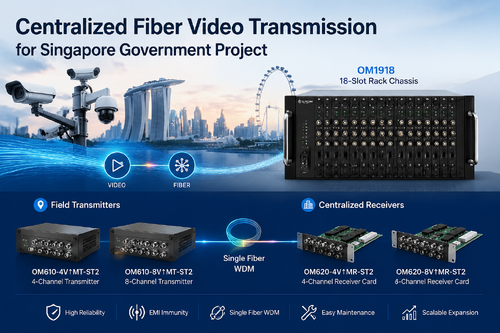
To meet these requirements, the project adopted OLYCOM's Fiber Optic Video Converter solution featuring standalone transmitters, rack-mounted receivers, and an 18-slot centralized chassis for equipment aggregation.

Project Challenges
Government surveillance systems demand significantly higher reliability than conventional commercial CCTV deployments. During system design, several technical challenges had to be addressed:
- Existing analog cameras needed to be retained to minimize replacement costs.
- Video signals had to be transmitted over optical fiber without degradation.
- The monitoring center required centralized equipment installation for simplified maintenance.
- Multiple surveillance channels needed to be managed efficiently inside a compact control room.
- The transmission system had to operate continuously with minimal maintenance requirements.
- Stable video quality was essential for long-term government security operations.
The engineering team therefore selected a fiber optic video transmission architecture rather than traditional coaxial cabling.
OLYCOM Solution
The project utilized a combination of standalone transmitters, rack-mounted receivers, and an 18-slot rack chassis to build a centralized analog video transmission system.
Products Deployed
Video Transmitters
OM610-4V↑MT-ST2
- 4-channel Analog Video Fiber Optic Transmitter
- Standalone Type
- Single Fiber Multimode
- ST Optical Connector
- 2 km Transmission Distance
OM610-8V↑MT-ST2
- 8-channel Analog Video Fiber Optic Transmitter
- Standalone Type
- Single Fiber Multimode
- ST Optical Connector
- 2 km Transmission Distance
Video Receivers
OM620-4V↑MR-ST2
- 4-channel Analog Video Fiber Optic Receiver
- Rack Card Type
OM620-8V↑MR-ST2
- 8-channel Analog Video Fiber Optic Receiver
- Rack Card Type
Central Equipment
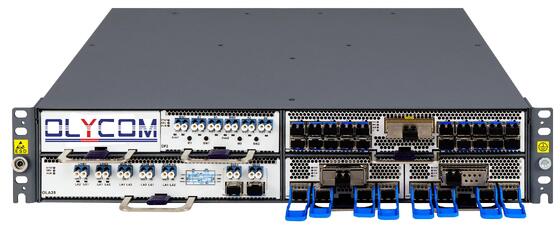
OM1918
- 18-slot Video Optical Converter Rack
- Dual AC100–240V Power Inputs
- Hot-swappable card installation
- Centralized rack management
System Architecture
Each surveillance location installed standalone fiber optic video transmitters close to the analog cameras.
The transmitters converted multiple analog video channels into optical signals and transmitted them through a single multimode fiber using WDM technology.
At the central monitoring room, rack-type receiver cards were installed inside the OM1918 18-slot chassis.
This architecture enabled all incoming video channels from different field locations to be terminated, organized, and managed within a single equipment rack.
Compared with deploying dozens of independent desktop receivers, the rack-mounted solution significantly reduced cabinet space while simplifying future expansion and maintenance.
The dual-power design of the OM1918 rack also enhanced system availability, an important consideration for government surveillance infrastructure operating around the clock.
Why an 18-Slot Rack Architecture?
One of the key design highlights of this project was the adoption of a centralized receiver chassis instead of multiple standalone receivers.
The 18-slot rack architecture provided several operational advantages:
Centralized Equipment Management
All receiver cards were installed inside one rack enclosure, allowing engineers to monitor, replace, or expand modules without disturbing adjacent equipment.
Higher System Reliability
The dual AC power supply reduced the risk of service interruption while supporting continuous 24/7 surveillance operations.
Space Optimization
A single OM1918 chassis accommodated multiple receiver cards, greatly reducing rack occupancy compared with standalone devices.
Simplified Maintenance
Hot-pluggable receiver modules allowed maintenance personnel to replace individual cards without shutting down the complete surveillance system.
Future Scalability
Additional receiver cards could be installed as surveillance cameras were added, protecting the customer's long-term investment.
Technical Advantages
The deployed Fiber Optic Video Converter solution offers several technical benefits that are particularly valuable in government security projects.
Uncompressed Video Transmission
The system delivers 8-bit digitally encoded analog video without compression, preserving image quality for surveillance and evidence recording.
Immunity to Electromagnetic Interference
Unlike coaxial cable, fiber optic transmission is immune to EMI and RFI, making it ideal for installations near electrical infrastructure and urban environments.
Single Fiber WDM Transmission
By utilizing WDM technology, bidirectional communication is achieved over a single optical fiber, reducing fiber resource consumption while simplifying installation.
Plug-and-Play Deployment
No optical adjustment or complicated configuration is required, enabling rapid installation and minimizing commissioning time.
Broadcast-Quality Video
The solution supports NTSC, PAL, and SECAM video formats while maintaining stable image quality throughout the transmission distance.
Continuous Government Operation
With industrial-grade design, LED status indicators, centralized rack management, and high system reliability, the solution is well suited for mission-critical surveillance networks.
Project Results
Following deployment, the government surveillance network achieved several operational improvements.
The centralized monitoring center became significantly easier to manage due to the adoption of rack-mounted receiver cards.
Fiber optic transmission eliminated the interference and signal degradation commonly associated with long-distance analog coaxial installations.
Maintenance efficiency improved because technicians could quickly identify module status through LED indicators and replace individual receiver cards without affecting the remaining channels.
The modular architecture also prepared the surveillance network for future camera expansion without requiring major infrastructure modifications.
Most importantly, the government agency obtained a highly reliable analog video transmission platform capable of supporting continuous security monitoring with stable image quality and simplified maintenance.
Conclusion
For organizations that continue operating analog CCTV infrastructure while requiring higher transmission reliability, centralized management, and long-term scalability, OLYCOM's Video Optical Converter solution provides an efficient migration path.
By combining standalone field transmitters, rack-mounted receiver cards, and the OM1918 18-slot chassis, this Singapore government project demonstrates how analog video can be transported reliably over fiber while achieving professional centralized equipment management.
Whether deployed in government facilities, transportation hubs, utilities, industrial plants, or critical infrastructure, OLYCOM's Analog Video over Fiber solutions deliver dependable performance, simplified maintenance, and flexible expansion for modern surveillance networks.


 Your message must be between 20-3,000 characters!