![]()
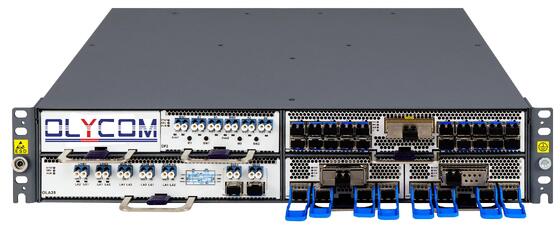
| Function | Note |
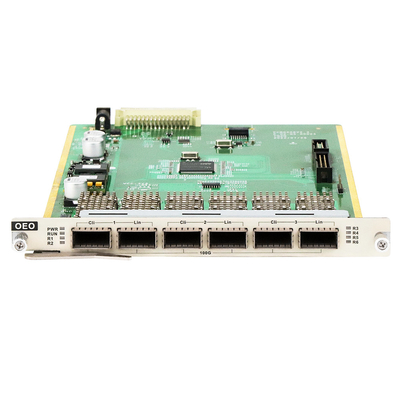
| Application | 100G wavelengths transform |
| interface |
Client-side interface: 3 QSFP28 hot-pluggable
WDM-side interface: 3 QSFP28 hot-pluggable |
| Line mode | Supports three 100G service transparent transmissions, which can transform three 100G service optical signals into two WDM standard wavelength optical signals |
| Support service type |
100GE OTU4 |
| Relay mode |
Support 40G&100G wavelength electrical relay Optical signal single, multi-mode transform |
| WDM technology | Support DWDM: C band 100GHz 40/48 waves,50GHZ 80/96 waves |
| Occupied slot number | Support OM3800 series chassis, occupy 1 slot , (0.5U) |
| Network management function |
Support real time monitoring of the port working state, including: transmitting optical power and receiving optical power, temperature, etc.
Support port loopback and port shutdown |
| Max power consumption | 30W (including Module) |
| MTBF | >100000 hours |
What is DWDM?
Definition
Dense Wavelength Division Multiplexing (DWDM) is an advanced optical fiber transmission technology that simultaneously carries multiple data streams across a single fiber strand by assigning each signal to a distinct wavelength of light. By stacking dozens to hundreds of independent optical channels on one fiber pair, DWDM exponentially increases available bandwidth without the need to deploy additional physical infrastructure — making it the cornerstone technology for long-haul backbone networks, submarine cable systems, and Data Center Interconnect (DCI) applications.
What Does DWDM Do?
One of DWDM's most strategically significant capabilities is its seamless integration with existing fiber optic infrastructure. Network operators and service providers can overlay DWDM systems onto already-deployed fiber plants, eliminating the capital expenditure associated with new cable construction while dramatically scaling transmission capacity.
As optical transceiver technology continues to evolve — from 100G to 400G and beyond — DWDM networks can be upgraded simply by replacing or adding line-side optics, allowing providers to scale capacity on demand without touching the physical fiber layer. This future-proof architecture ensures that investments made today remain relevant as traffic demands grow.
Key Technical Advantages
- High Channel Density — ITU-T standardized channel spacing (typically 50 GHz or 100 GHz) enables up to 80+ channels per fiber pair
- Extended Reach — Combined with optical amplifiers (EDFA) and dispersion compensation, DWDM supports transmission spans of thousands of kilometers with minimal signal degradation
- Protocol Transparency — Capable of carrying Ethernet, OTN, SONET/SDH, and Fibre Channel traffic simultaneously across the same optical layer
- Scalable Architecture — Reconfigurable Optical Add-Drop Multiplexers (ROADMs) enable dynamic wavelength management and flexible network provisioning
- Cost Efficiency — Maximizes the return on existing fiber assets, significantly reducing cost-per-bit for high-capacity routes
Why DWDM Matters
As global IP traffic continues to surge driven by cloud computing, 5G backhaul, and streaming media, DWDM remains the most bandwidth-efficient and cost-effective solution for scaling optical transport networks. Its ability to multiply fiber capacity while integrating with next-generation coherent optics makes it an indispensable technology for any carrier-grade or enterprise optical network deployment.