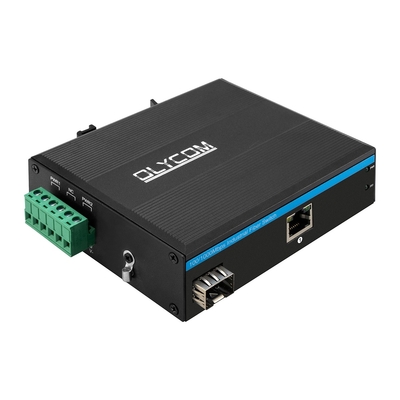
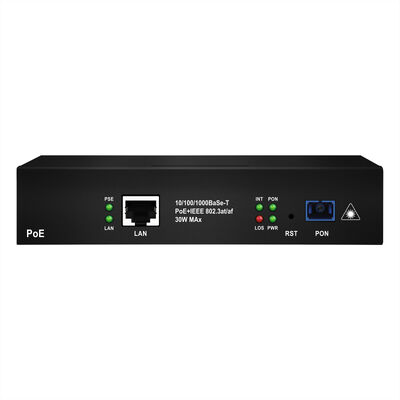
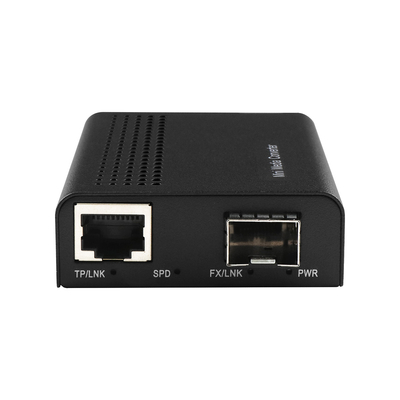
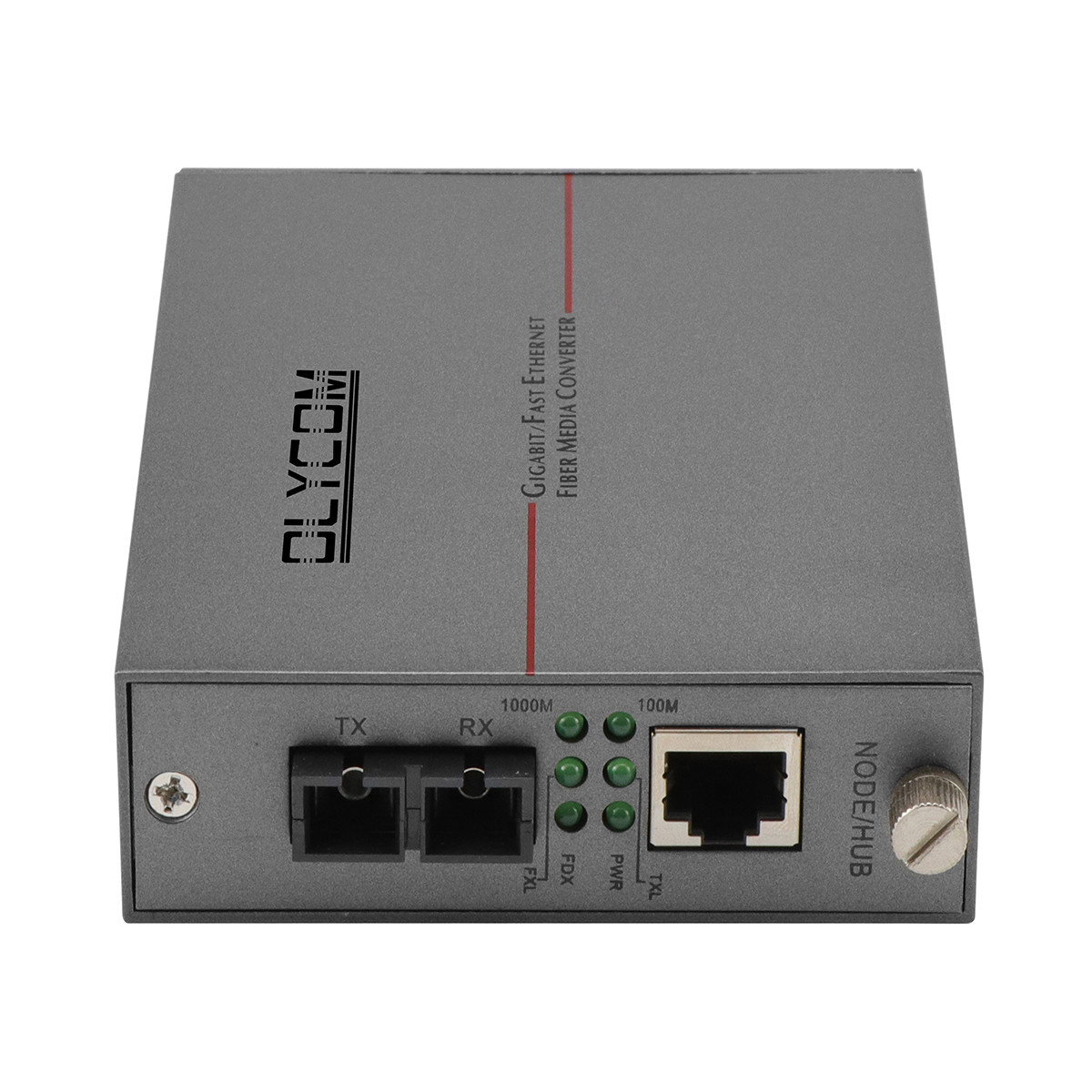
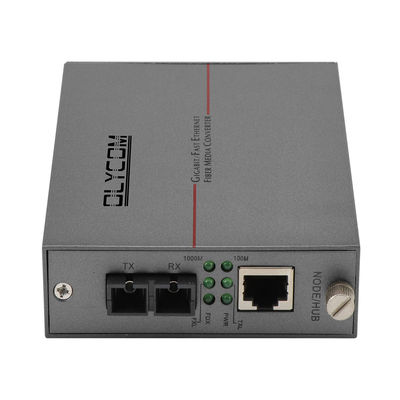
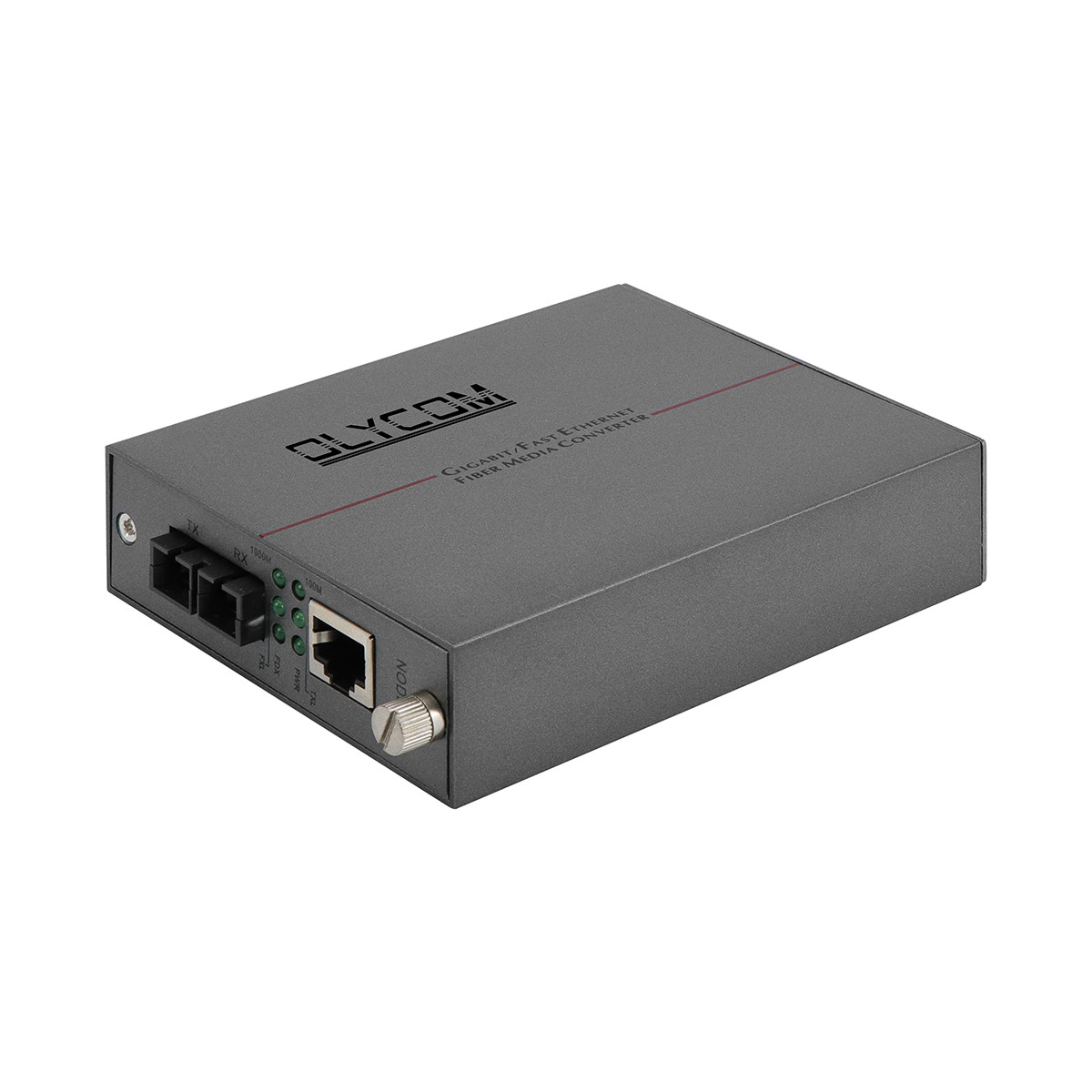
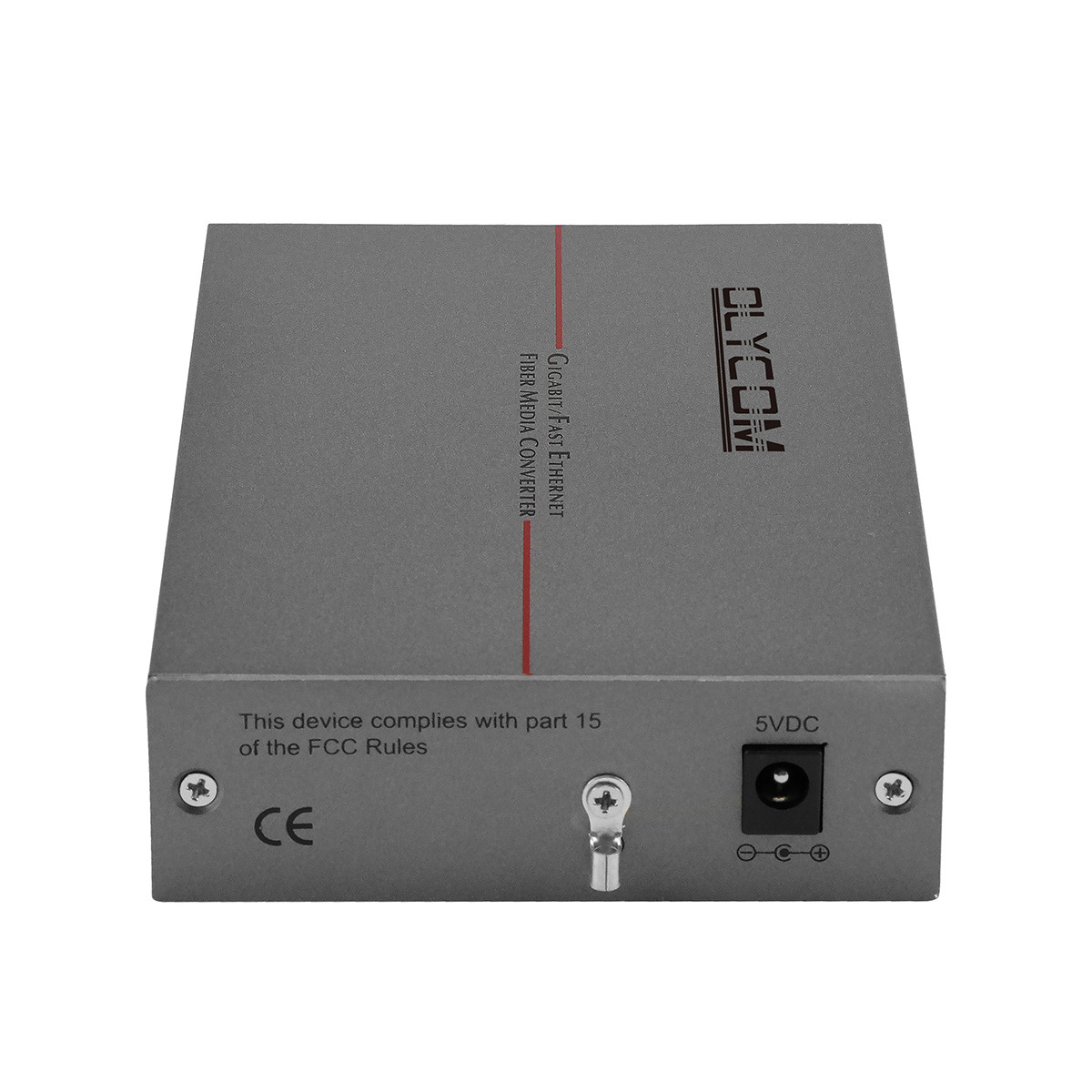
Single Mode Fiber Optic Gigabit Ethernet Media Converter
Introduction to Unmanaged Media Converter
- The unique premium TA340-GE series features flexible swap-ability (same card for standalone units and 19” 2U chassis)
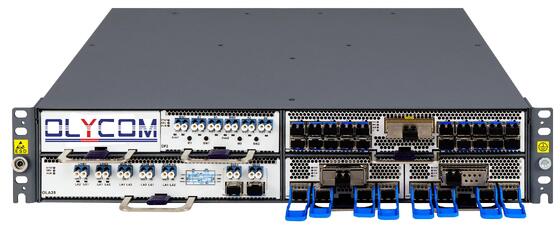
- Versatile compatibility with 19”2U systems, and customized design.
- Utilize 2-core optical fiber to extend the physical distance range of typical Ethernet links (1000m) to 2Km max. on MMF and 120Km max. on SMF.
Key Features of Fiber Optic Extender
- 10/100/1000Mbps autosensing, auto-MDI/MDIX
- 10K super data packet transmission
- Link fault pass through (LFPT)
- Support AVB
- Unique premium aluminum compact closure
- Same swappable card for standalone units and 19” 2U systems
Specification of Gigabit Media Converter
| Standard |
IEEE802.3 (10BASE-T), IEEE802.3u 100BASE-TX/FX (Fast-Ethernet),
IEE802.3z 1000BASE-SX/LX(Gigabit-Ethernet), IEEE802.3x (Flow Control), IEEE802.1q, IEEE802.1p QoS, IEEE802.1d Spanning Tree, IEEE1588V2, IEEE802.3az
|
| 10/100/1000BASE-T |
STP or UTP Category 5/5e/6 cable (Max. 100m) |
| 1000BASE-FX |
50/125um fiber cable (5km), 62.5/125um multimode fiber cable (2km)
9/125um singlemode fiber cable (20/40/60/80/100km)
|
| Conversion Mode / Delay Time |
Store-and-Forward < 10us, straight-through<0.9us |
| Flow control |
Full duplex-flow control, Half duplex-back pressure |
| RJ-45 Port |
Auto-MDI/MDIX |
| Fiber Connector |
SC standard, ST/FC optional |
| Wavelength |
1310/1550nm |
| Input Voltage |
DC 5V1A with External power adapter |
| Power Consumption |
<2.5W |
| MTBF |
50,000 hours |
| BER |
<1/1000000000 |
| MAC Address Table |
4K |
| Buffer Size |
1.75M |
| Operating Temperature |
0℃~50℃ |
| Storage Temperature |
-40℃~70℃ |
| Storage Humidity |
5%~90% non-condescending |
| Dimensions |
117mm(W) x 90mm(D) x 28mm(H) |
| Weight |
Net weight : 0.18kg, Gross weight : 0.44kg |
Application of Ethernet Fiber Optic Converter

- Telecommunication Networks
- Schools, Offices, Cyber Bars
- FTTX Projects
Ordering Infomation of Network Media Converter
| TA340-GE/M05 |
10/100/1000M, MM, dual fiber, 550m, SC, 1310nm, standalone, premium casing, external PSU |
| TA340-GE/S20 |
10/100/1000M, SM, dual fiber, 20km, SC, 1310nm, standalone, premium casing, external PSU |
| TA340-GE/S40 |
10/100/1000M, SM, dual fiber, 40km, SC, 1310nm, standalone, premium casing, external PSU |
| TA340-GE/S60 |
10/100/1000M, SM, dual fiber, 60km, SC, 1550nm, standalone, premium casing, external PSU |
| TA340-GE/S80 |
10/100/1000M, SM, dual fiber, 80km, SC, 1550nm, standalone, premium casing, external PSU |
| TA340-GE/S100 |
10/100/1000M, SM, dual fiber, 100km, SC, 1550nm, standalone, premium casing, external PSU |
OEM/ODM
- OEM and ODM services are optional.
- We are fully connected with our customers, even if just for a single purchase.
- The Customer information will be highly confidential, and relevant cooperation information will not be leaked to a third party without the customer’s permission.
It starts from the promise of professional products and services, but our work goes far beyond. It is not only fiber optic connection, but also human connection.
FAQ
1. What fiber types and maximum transmission distances does this media converter support?
The TA340-GE supports both multi-mode and single-mode fiber, covering a wide range of transmission distances to suit different project scales and existing fiber infrastructure.
On multi-mode fiber, it supports distances of up to 2km on 62.5/125μm cable and up to 5km on 50/125μm cable, making it suitable for intra-campus and inter-building connections. On single-mode fiber, it supports distances of 20km, 40km, 60km, 80km, and up to 120km on 9/125μm cable, covering everything from metro network links to long-haul connections across large geographical areas.
The standard fiber connector is SC, with ST and FC available as optional alternatives, and both 1310nm and 1550nm wavelengths are supported, giving full flexibility to match your existing fiber plant without additional adapters or patch panels.
2. What is Link Fault Pass-Through (LFPT), and why does it matter for my network?
Link Fault Pass-Through, abbreviated as LFPT, is a fault propagation feature that automatically brings down the copper RJ45 port whenever a failure is detected on the fiber side of the link, and vice versa.
Without LFPT, a switch or router connected to the copper port would continue to believe the end-to-end link is active even when the fiber connection has failed, causing traffic to be sent into a broken link silently. This makes fault diagnosis significantly more difficult and can delay network recovery. With LFPT enabled, the connected switch immediately detects the link-down event and can trigger failover, spanning tree recalculation, or alert generation automatically.
This feature is particularly important in managed network environments, redundant ring topologies, and any deployment where fast and accurate fault detection is critical to maintaining service availability.
3. Can this converter be used both as a standalone unit and inside a 19-inch rack chassis?
Yes, and this is one of the most distinctive features of the TA340-GE series. The module card is designed to be fully swappable between standalone desktop operation and installation into a 19-inch 2U rack chassis without any hardware modification.
This means you can initially deploy converters as standalone units during early project phases or in smaller installations, and later migrate the same cards directly into a centralized rack chassis as your network grows, without replacing the converter modules themselves. This protects your initial hardware investment and significantly simplifies future network expansion and centralized management.
The compact aluminum enclosure also contributes to efficient heat dissipation in both deployment configurations, and with a power consumption of less than 2.5W per unit, thermal management in densely populated chassis installations remains straightforward.
4. What advanced network features does this converter support beyond basic media conversion?
Beyond standard fiber-to-copper media conversion, the TA340-GE supports several advanced networking capabilities that make it suitable for more demanding and feature-rich network environments.
It supports IEEE 802.1q VLAN tagging, IEEE 802.1p QoS priority marking, and IEEE 802.1d Spanning Tree Protocol, allowing it to participate transparently in managed network topologies without stripping or altering traffic classification. IEEE 1588v2 Precision Time Protocol support makes it suitable for applications requiring highly accurate time synchronization across the network, such as industrial automation, financial trading systems, and broadcast production environments.
It also supports AVB (Audio Video Bridging) and 10K Jumbo Frame transmission, making it well suited for high-bandwidth multimedia and storage networking applications where large packet sizes and time-sensitive streaming are essential requirements.


 Your message must be between 20-3,000 characters!