Project Overview
A customer required a high-capacity DWDM point-to-point transmission system to interconnect two data center locations over an existing dark fiber infrastructure.
The primary requirements included:
|
Item
|
Requirement
|
|
Service Type
|
10GE Ethernet
|
|
Initial Capacity
|
200G
|
|
Future Expansion
|
400G
|
|
Fiber Distance
|
50Km
|
|
Fiber Loss
|
15~18dB
|
|
Protection
|
Optical Line Protection (OLP)
|
|
Architecture
|
Point-to-Point DWDM
|
|
Expansion Strategy
|
Pay-as-you-grow
|
The customer planned to activate only 20 x 10G services in the initial phase and expand to 40 x 10G services later without replacing the existing DWDM platform.
Design Objectives
The project design focused on the following engineering objectives:
-
Support 200G coherent transmission over 50km fiber
-
Allow seamless upgrade to 400G
-
Ensure high transmission stability under 15~18dB fiber attenuation
-
Provide optical protection redundancy
-
Minimize CAPEX during phase-1 deployment
-
Preserve optical layer investment for future expansion
Solution Architecture
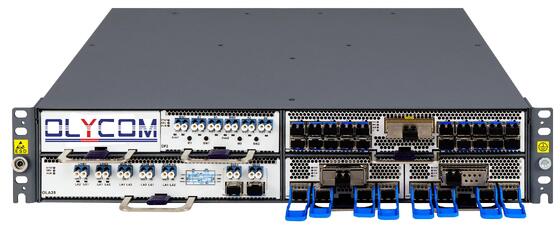
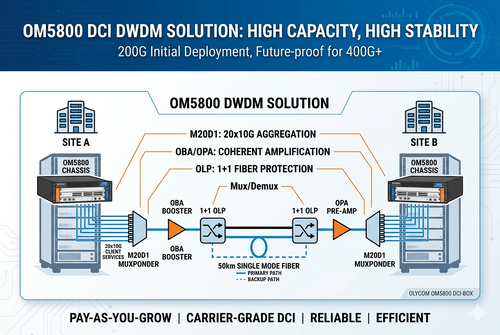
The proposed solution is based on the Olycom OM5800 DCI-BOX coherent DWDM platform.

1. System Architecture
Site A
↓
OM5800 DWDM Platform
↓
50km Single Mode Fiber
↓
OM5800 DWDM Platform
↓
Site B
2. Equipment Configuration
2.1 Optical Layer
|
Module
|
Function
|
|
OMD08
|
8CH DWDM Mux/Demux
|
|
OP1
|
1+1 Optical Line Protection
|
|
OBA
|
Booster Amplifier
|
|
OPA
|
Pre-Amplifier
|
|
OCM (Optional)
|
Optical Channel Monitoring
|
|
OTDR (Optional)
|
Fiber Monitoring
|
2.2 Electrical Layer
Phase 1 — 200G Deployment
|
Module
|
Function
|
|
M20D1
|
20 x 10GE → 1 x 200G coherent muxponder
|
Phase 2 — 400G Expansion
|
Module
|
Function
|
|
2*M20D1
|
2*20 x 10GE → 2 x 200G coherent muxponder
|
|
T4Q1(Optional)
|
4 x 100GE → 1 x 400G coherent transponder
|
Engineering Design Details
1. Client Service Aggregation
The M20D1 muxponder card aggregates twenty 10GE client services into one 200G coherent optical wavelength.
Technical Characteristics
|
Parameter
|
Specification
|
|
Client Interfaces
|
20 x SFP+ 10GE
|
|
Line Interface
|
1 x CFP2-DCO 200G
|
|
DWDM Grid
|
50GHz C-band Tunable
|
|
Modulation
|
QPSK / 16QAM
|
|
FEC
|
oFEC
|
|
Service Mapping
|
ODU2 → ODUC2 → OTUC2
|
The coherent CFP2-DCO module provides enhanced OSNR tolerance and improved transmission performance compared with traditional gray optics.
2. Optical Link Budget Analysis
Fiber Conditions
|
Item
|
Value
|
|
Fiber Distance
|
50Km
|
|
Fiber Attenuation
|
15~18dB
|
|
Connector/Splice Margin
|
2~3dB
|
|
Total Estimated Link Loss
|
18~21dB
|
Because the total optical attenuation approaches the coherent receiver sensitivity threshold, EDFA amplification is introduced.
EDFA Amplification Design
The solution adopts:
|
Amplifier Type
|
Position
|
|
OBA
|
Transmit Side Booster
|
|
OPA
|
Receive Side Pre-Amplifier
|
Optional OLA line amplification can be added for future higher-capacity deployment.
EDFA Characteristics
|
Item
|
Value
|
|
Gain
|
Up to 33dB
|
|
Output Power
|
Up to +20dBm
|
|
Noise Figure
|
Typical 5dB
|
|
Working Band
|
C-band 1528~1565nm
|
The amplifier design ensures sufficient OSNR margin for coherent 200G transmission over the entire optical span.
3. DWDM Channel Planning
Phase 1
|
Resource
|
Usage
|
|
Active Channels
|
1
|
|
Occupied Capacity
|
200G
|
|
Reserved Channels
|
7
|
Phase 2
|
Resource
|
Usage
|
|
Active Channels
|
2
|
|
Occupied Capacity
|
400G
|
|
Reserved Channels
|
Future Expansion
|
The OMD08 platform supports up to 8 wavelengths on a 50GHz DWDM grid, allowing future migration toward:
-
400G coherent wavelengths
-
800G coherent wavelengths
-
ROADM networking
-
Multi-site DCI architecture
4. Optical Protection Design
To guarantee service continuity, the system integrates OP1 Optical Line Protection.
Protection Features
|
Function
|
Description
|
|
Protection Mode
|
1+1 Fiber Protection
|
|
Switching Time
|
<15ms
|
|
Operation Mode
|
Automatic / Manual
|
|
Recovery Mode
|
Supported
|
|
Interface
|
Name
|
Function
|
|
LINE IN
|
PA/LA/BA Input Interface
|
Small signal optical power input port.
|
|
SIG OUT
|
PA/LA/BA Output interface
|
EDFA amplified output optical port.
|
|
OTDR IN1
|
OTDR Input Interface
|
OTDR signal input optical port
|
|
MON OUT
|
Monitoring port
|
EDFA performance monitoring interface, connect to OPM or spectrometer.
|
|
WDM COM
|
COM port
|
WDM COM optical port
|
|
WDM 1510
|
1510 Signal
|
1510 Signal Light Port
|
|
WDM 1550
|
1550 Signal
|
1550 Signal Light Port
|
|
OSC OUT
|
Monitoring channel output port
|
Link SFP RX to transmit network management information.
|
|
RX
|
Optical module input port
|
Transmit network management information
|
|
TX
|
Optical module output port
|
Transmit network management information
|
Protection Mechanism
1. Under normal conditions: Traffic runs on the primary optical path, secondary fiber remains standby
2. When fiber degradation or interruption occurs: Optical power monitoring detects abnormality
OP1 automatically switches traffic to backup path and dervice interruption is minimized to milliseconds
This architecture significantly improves network availability and SLA reliability.
5. Future Expansion Strategy
The customer requested long-term scalability without major hardware replacement.
The OM5800 platform supports:
|
Upgrade Direction
|
Capability
|
|
200G → 400G
|
Supported
|
|
400G → 800G
|
Supported
|
|
Fixed Grid → Flexible Grid
|
Supported
|
|
Point-to-Point → ROADM
|
Supported
|
The customer can gradually increase service bandwidth while reusing:
-
Existing chassis
-
DWDM mux/demux
-
Optical amplifiers
-
Protection system
-
Fiber infrastructure
This minimizes future upgrade costs and operational disruption.
Rack-Level Deployment
Per Site Suggested Configuration
|
Equipment
|
Quantity
|
|
OM5800 Chassis
|
1
|
|
M20D1 Card
|
1~2
|
|
OP1 OLP Card
|
1
|
|
OBA Amplifier
|
1
|
|
OPA Amplifier
|
1
|
|
OMD08 DWDM Module
|
1
|
|
Dual Power Modules
|
2
|
Operational Advantages
1. High Reliability: Coherent transmission technology
- 1+1 optical protection
- Redundant power supply
- Fast fault recovery
2. Efficient Fiber Utilization
- Multiple 10GE services over single fiber pair
- Reduced leased fiber requirements
- Simplified Upgrade Path
3. Modular architecture
- Hot-swappable service cards
- Scalable coherent optics
4. Carrier-Grade Architecture
- Optical monitoring support
- OTDR integration capability
- OCM wavelength supervision
- Network management integration
Conclusion
The OM5800 coherent DWDM platform successfully delivered a scalable and carrier-grade DCI transmission solution for the customer’s 50km metro optical network.
The project achieved:
-
Initial 200G deployment
-
Smooth migration path toward 400G
-
Reliable transmission over 15~18dB optical loss
-
Fast optical protection switching
-
Long-term infrastructure investment protection
This case demonstrates the flexibility and scalability of the OM5800 platform for enterprise DCI, carrier transport, and metro optical backbone applications.


 Your message must be between 20-3,000 characters!