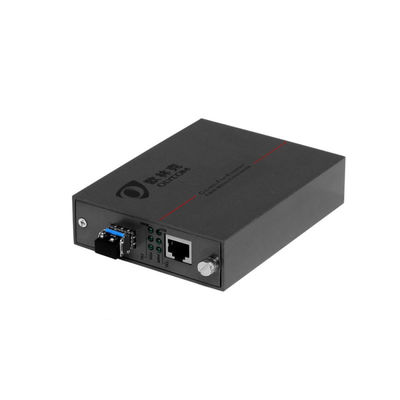
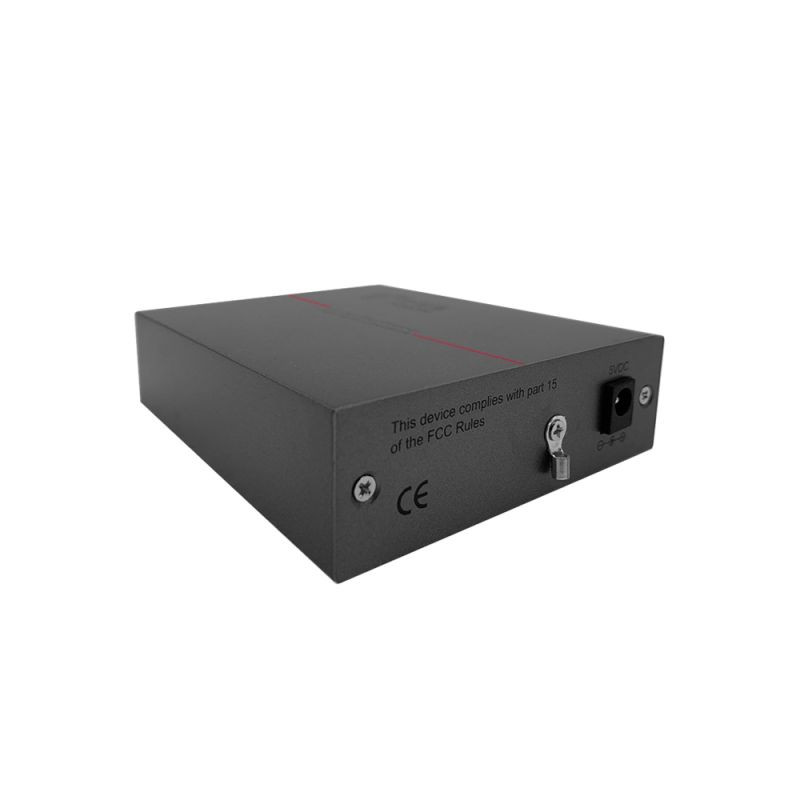
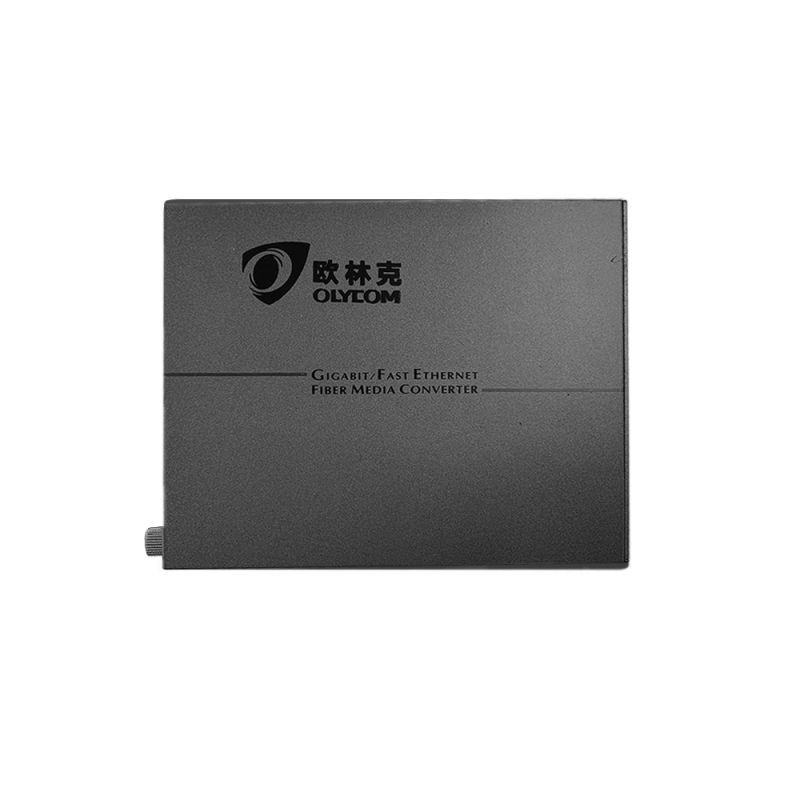
Gigabit PoE Fiber Optic Media Converter
Product Introduction
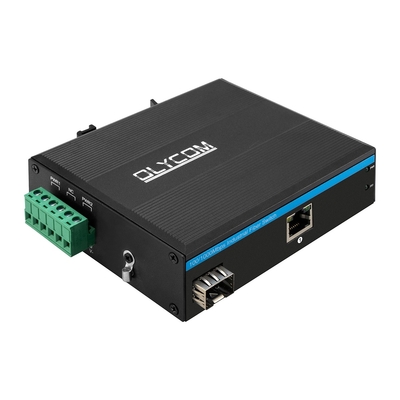
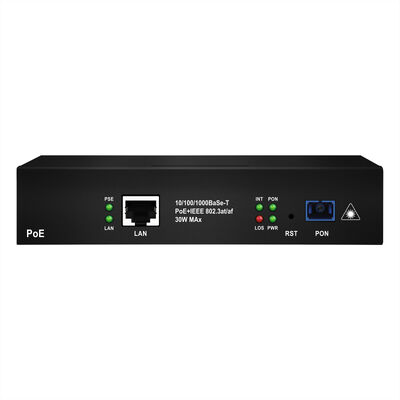
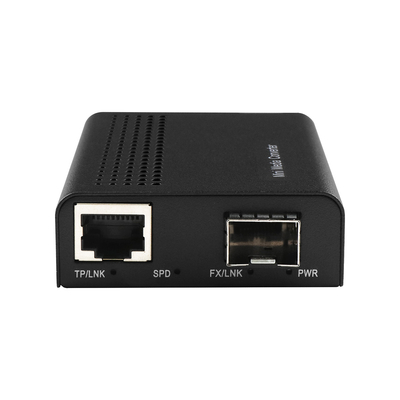
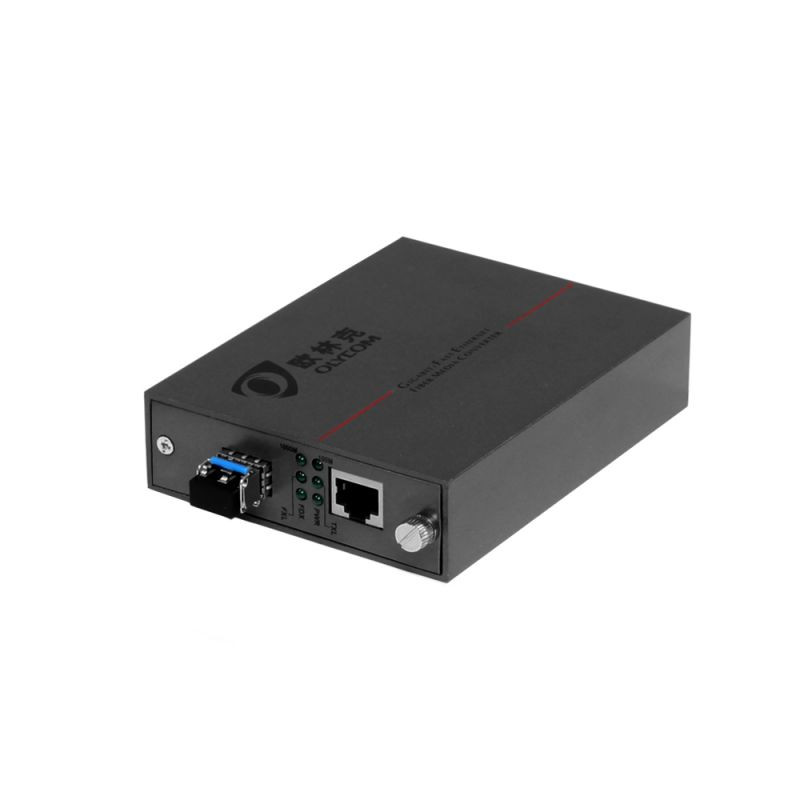
Olycom 10/100/1000Mbps POE PSE PD Ethernet to fiber media converter features below
-
IEEE 802.3af/at Power Sourcing Ethernet (PSE) functionality on the twisted pair port
-
Supplying both data and electric current to devices
-
Widely used in WiFi access points, VoIP phones and IP security cameras
-
Unique premium aluminum compact case
Key Features
-
1 x 10/100/1000Base-TX port for data and power
-
External power supply
-
1 x 1000Base-FX or SX fiber port
-
Support AVB
-
Link fault pass through (LFPT)
-
IEEE802.3af/at compliant
Technical Parameters
|
Standard
|
IEEE802.3(10Mbps), IEEE802.3u (100Mbps), IEEE802.3z(1000Mbps), IEEE802.3x (Flow Control), IEEE802.1q, IEEE802.1p QoS, IEEE802.1d Spanning Tree, IEEE802.3af PoE/PSE
|
|
10/100/1000BASE-T
|
STP or UTP Category 5/5e/6 cable (Max. 100m)
|
|
1000BASE-FX
|
50/125um(1Km), 62.5/125um MMF (550m), 9/125um SMF (20/40/60/80/100km)
|
|
Conversion Mode
Delay Time
|
Store-and-Forward < 10us
Straight-through<0.9us
|
|
Flow control
|
Full duplex-flow control, Half duplex-back pressure
|
|
RJ-45 Port
|
Auto-MDI/MDIX
|
|
Fiber Connector
|
LC standard, SC/FC optional
|
|
Wavelength
|
1310/1550nm
|
|
Input Voltage
|
48VDC/1A external power supply
|
|
Power Consumption
|
<2.5W
|
|
PoE pin assignment
|
1/2 (V+),3/6 (V-)
|
|
PoE Output
|
-48V, 0.54A, 25W
|
|
MTBF
|
50,000 hours
|
|
BER
|
<1/1000000000
|
|
MAC Address Table
|
4K
|
|
Buffer Size
|
1.75M
|
|
Operation Temperature
|
0℃~50℃
|
|
Storage Temperature
|
-20℃~85℃
|
|
Storage Humidity
|
5%~90% non-condescending
|
|
Dimensions and Weight
|
135mm(L) x 90mm(W) x 28mm(H)
Net weight : 0.3kg, Gross weight : 0.5kg
|
Application
-
Schools, Offices, Cyber bars
-
FTTX Projects
-
Telecommunication Networks

Ordering Details
|
TA343-PSE-GE
|
PSE/PoE fiber media converter, 10/100/1000Mbps, single port, 220VAC in -48VDC out, 25W, without SFP module
|
|
TA343-PSE-GE/ M05-LC
|
PSE/PoE fiber media converter, 10/100/1000Mbps , single port, 220VAC in -48VDC out, 25W, MMF, dual fiber, 1310nm, 550M, LC
|
|
TA543-PSE-GE/ S20- SC
|
PSE/PoE fiber media converter, 10/100/1000Mbps , single port, 220VAC in -48VDC out, 25W, SMF, single fiber, 1310nm / 1550nm, 20Km, SC
|
FAQ
1. What is Link Fault Pass-Through (LFPT), and why is it important?
Link Fault Pass-Through, commonly abbreviated as LFPT or LFP, is a fault detection and notification feature built into this media converter. When a failure is detected on the fiber side of the link, the converter automatically brings down the corresponding RJ45 copper port to notify the connected device that the end-to-end link is no longer available.
Without this feature, a switch or router connected to the copper port would continue to believe the link is active even when the fiber connection has failed, which can cause traffic loss that is difficult to diagnose. LFPT makes network fault detection faster and more reliable, which is especially critical in managed network environments where spanning tree protocols or failover mechanisms depend on accurate link status reporting.
2. Does this media converter support both single-mode and multi-mode fiber?
Yes. This media converter is equipped with an open SFP slot rather than a fixed fiber interface, meaning the fiber type and transmission distance are determined by whichever SFP module is inserted.
By simply choosing the appropriate SFP module, you can support multi-mode fiber for short-distance connections of up to 550 meters, or single-mode fiber for long-distance links reaching up to 20km, 40km, 80km, or beyond depending on the module selected.
This design gives you maximum flexibility across different project requirements without needing to purchase a separate converter for each fiber type, making it a highly cost-effective and future-proof solution.
3. Does this converter support Digital Diagnostic Monitoring (DDM)?
Yes, this media converter supports DDM, also known as DOM (Digital Optical Monitoring), through its SFP slot when a DDM-capable SFP module is installed.
DDM allows you to monitor real-time optical parameters including transmit power, receive power, temperature, supply voltage, and laser bias current directly from a compatible management interface. This gives network administrators valuable visibility into the health of the optical link without requiring additional test equipment.
This feature is particularly useful for proactive maintenance, allowing potential issues such as dirty connectors, fiber degradation, or aging laser components to be identified and addressed before they result in a link failure.
4. What devices is this Gigabit SFP media converter compatible with, and where is it typically used?
This media converter is fully compliant with IEEE 802.3, IEEE 802.3u, and IEEE 802.3ab standards, ensuring broad compatibility with network equipment from all major vendors including Cisco, Huawei, H3C, MikroTik, and others.
It is widely deployed in scenarios where a network switch lacks a built-in fiber uplink port and a fiber-to-copper conversion is needed, such as connecting a fiber backbone to a copper-based access layer, extending network links between buildings, or integrating fiber infrastructure into existing Ethernet environments.
Its support for auto-negotiation at 10/100/1000Mbps on the copper side ensures seamless connectivity with virtually any end device, while the open SFP slot makes it adaptable to a wide range of fiber plant configurations.


 Your message must be between 20-3,000 characters!